The Vision of a Unified Decentralized Operating Layer
By Cropr AdminThis has happened before
The capital markets we know today were built over decades, by people who understood that fragmentation was the enemy of efficiency.
Bloomberg terminals became the standard because accessing that data in an otherwise fragmented, manual, disconnected way was costing real money, time, and opportunity.
Similarly, when we looked at what is happening in decentralized finance, we saw a pattern we recognized immediately. Not because it was new, but because it was an almost perfect replay of the traditional financial market. A market with extraordinary depth and opportunity, held back by the absence of the professional infrastructure its actors urgently needed.
So we started building.
The problem we set out to solve
Decentralized finance compressed decades of financial innovation into a handful of years. Lending and borrowing, derivatives and structured products, market liquidity and yield strategies — primitives that took traditional finance generations to develop were reimagined, rebuilt, and made permissionless in a matter of months.
While remarkable, it still lacks the supporting infrastructure required to professionally manage portfolios and positions to meet institutional needs.
Even today’s power users manage positions across multiple protocols and chains, each with their own dedicated wallet connected manually without any standardized, aggregated view.
Keeping the books in this mostly analog manner can feel like an inconvenience, but it is, at its core, a structural risk. An invisible cost. A ceiling.
We decided that someone needed to resolve this industry-wide gap, so we built CROPR.
The market that made our case stronger
Since we’ve envisioned the core concept for CROPR, the market continued to evolve. It has professionalized. And with that professionalization has come a new class of increasingly sophisticated actors who are still facing the same infrastructure gap. Now with an even more fragmented market of chains, trading venues, lending and borrowing protocols, AMM pools, derivative instruments and vaults, even professionals struggle to combine them.
The Bloomberg Terminal solved the same problems in traditional finance, but money onchain has specific needs:
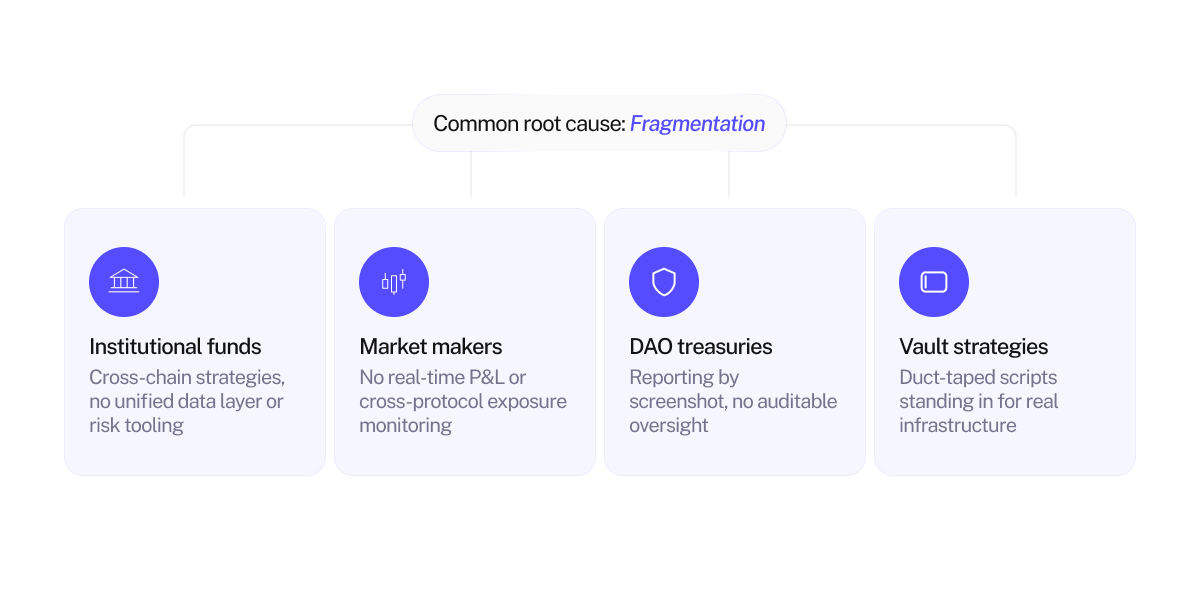
Institutional funds are managing increasingly complex cross-chain strategies
The era of a crypto fund holding BTC and ETH in a simple custodial wallet is largely over. Today's liquid crypto funds operate across multiple chains simultaneously, running basis trades, delta-neutral yield strategies, leveraged positions, and structured products. Often within a single portfolio. The complexity of tracking, valuing, and risk-managing these positions is non-trivial. At best, most operate with expensive to maintain, in-house software, with no truly unified data layer or transferable professional tooling. It results in a messy, operational nightmare.
Market makers and trading desks have expanded their mandates
In the search for novel revenue streams, market makers and trading desks must deploy tailor-made, high effort initiatives and strategies. These operations need real-time P&L visibility, cross-protocol exposure monitoring, and granular position accounting. What they have instead is a collection of disconnected on-chain data and manual reconciliation workflows that would be considered unacceptable in any other professional context.
DAO treasury operations as a massive bottleneck
With a mandate to preserve capital while achieving reasonable risk-adjusted returns, the main challenge for DAOs is to deploy idle capital while keeping full and transparent oversight. Reporting is usually, unfortunately, by screenshots and spreadsheets: slow to produce and impossible to audit without aggressive interrogation. Further, the yield landscape changes fast enough that evaluating venues properly is itself a full-time research job that no treasury team has capacity for. The governance mechanisms exist. The capital is there. The operating layer to deploy and manage it safely, swiftly, and accountably is not.
The vault revolution has fundamentally changed how capital is deployed
What began as yield farming strategies and simple lending vaults is evolving into a rich ecosystem of multi-strategy composable structures. Combined lending optimization, AMM liquidity provision, derivatives hedging, and cross-chain rebalancing into single instruments. Managing these structures requires operational sophistication that the market has not yet equipped its participants to achieve. Instead, they build their own scripts, duct-taped systems, and alerts to manage them. An operational risk and a burden to scale.
The common thread across every one of these segments is fragmentation and the complexity therein to manage it. With assets distributed across wallets, chains, and protocols, the data is siloed, inconsistent, and delayed. The risk is everywhere and visible nowhere. And the reporting — the single most important output for any fiduciary actor — is a manual, error-prone, time-consuming exercise that introduces its own category of risk.
What professional operators actually need
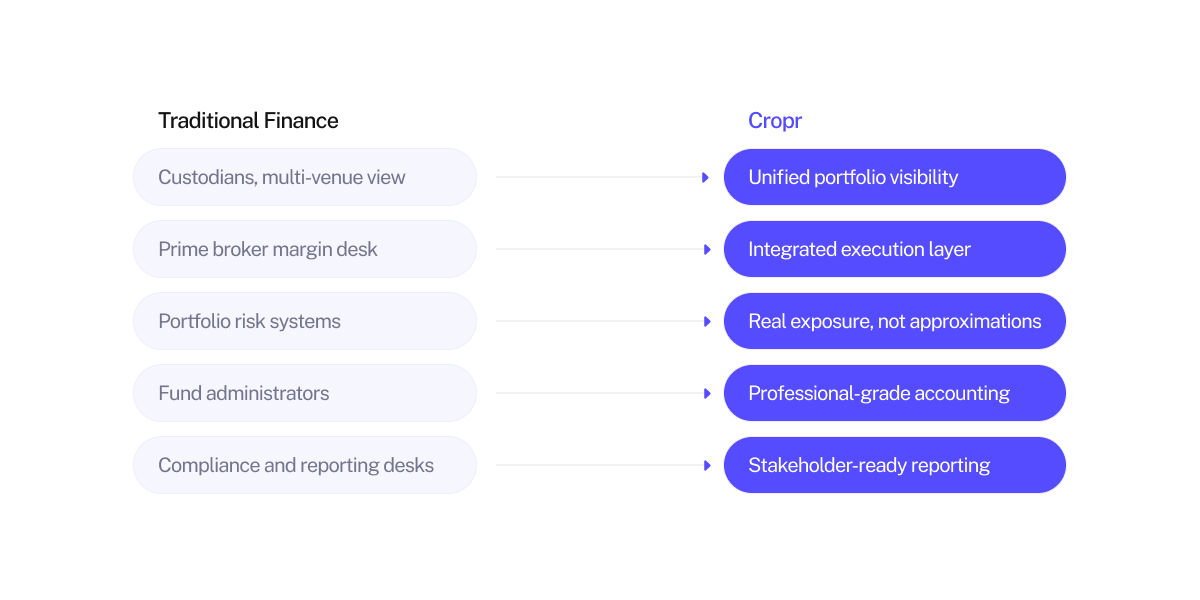
In traditional finance, the answer to all of the above is institutional infrastructure. Custodians who aggregate positions across venues. Prime brokers who provide unified margin and reporting. Risk systems that give portfolio managers a live picture of exposure across every instrument and counterparty. Fund administrators that track the cost basis, valuation, and P&L of every position in real time. All bloated in their own way.
Modern DeFi professionals now need the same tooling, but without the legacy dragbloat:
- Unified portfolio visibility across every chain, wallet, and protocol.
- An integrated execution layer to act upon complex strategies.
- Risk management that informs real exposure, not approximations.
- Professional-grade accounting — proper cost basis tracking, position valuation at mark-to-market and historical cost, and automated reconciliation.
- Compliance and reporting infrastructure that can speak to every stakeholder in their capital structure — from internal teams to LPs to DAO token holders to regulators — with the speed, accuracy, and professional presentation those audiences require.
Without this infrastructure, every new strategy devised comes with a hidden operational cost. We’ve seen many strategies never get implemented not simply because they lacked merit, but because the operational complexity of managing them safely exceeded the capacity of existing tools. That capital ends up being left on the table, at scale, across the entire industry.
CROPR: The Operating Layer for Professional Digital Asset Management
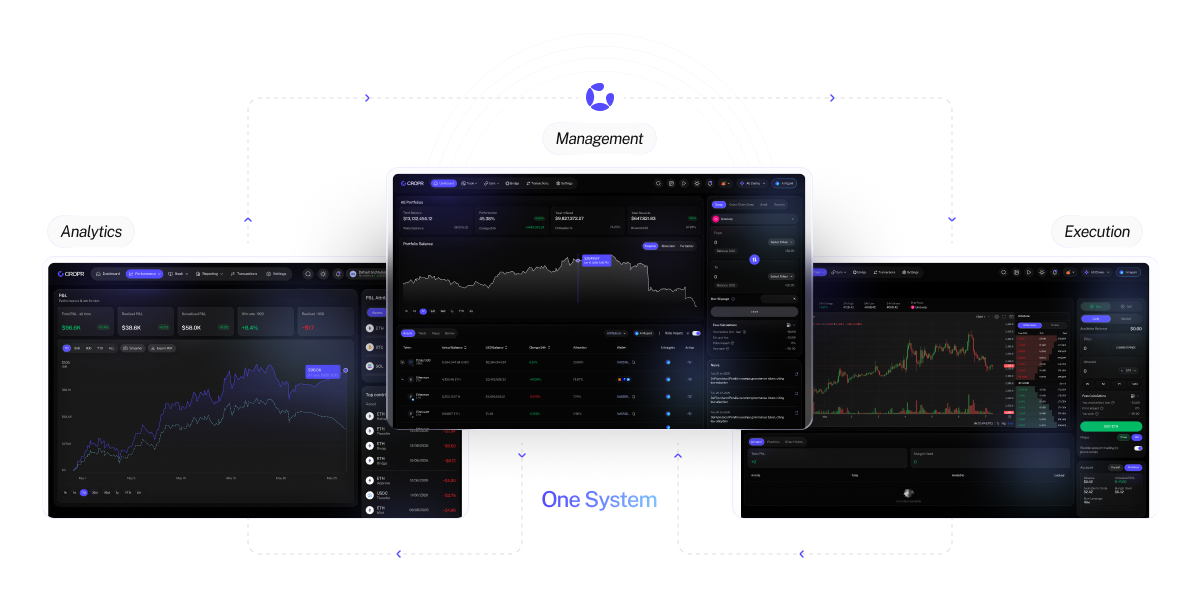
Not a portfolio tracker. Not a yield aggregator. Not another DeFi interface. The operating layer — the Copilot — that makes professional digital asset management strategies truly manageable as a closed loop without friction.
CROPR’s foundation is a unified data architecture: a single vantage point of an entire portfolio. Every position and every transaction recorded across every supplied wallet, chain, and protocol. The fragmentation that defines today's DeFi is still its main advantage over other markets, and we made sense of it.
On top of that foundation, we built the execution layer to trade across decentralized and centralized spot and perps markets, swap and bridge across chains, deploy capital in staking, lending, AMM pools for any composable strategy. Additionally, the CROPR platform shows users real-time valuation with proper accounting methodologies, risk pivots that surface actual exposure, P&L attribution and contribution across strategies and positions, with reporting frameworks that can be configured to the specific needs of all user segments.
Critically, we achieve this while preserving everything that makes decentralized finance powerful to investors. Permissionless self-custody throughout with seamless connectivity access to every integrated protocol without additional counterparty risk. Think of CROPR as the orchestration layer that leaves the underlying settlement network untouched.
The AI Imperative
There is a dimension to modern DeFi that no amount of manual tooling can address: the sheer volume and velocity of the information environment.
Onchain data flows in a format and at a pace that from its inception has exceeded human processing capacity. Whether it be protocol parameter changes, liquidity dynamics, yield curve shifts, governance proposals, macro signals, the actors who succeed are those who can augment their judgment with scaled intelligence.
This is where CROPR's AI layer becomes not just a feature, but a structural advantage.
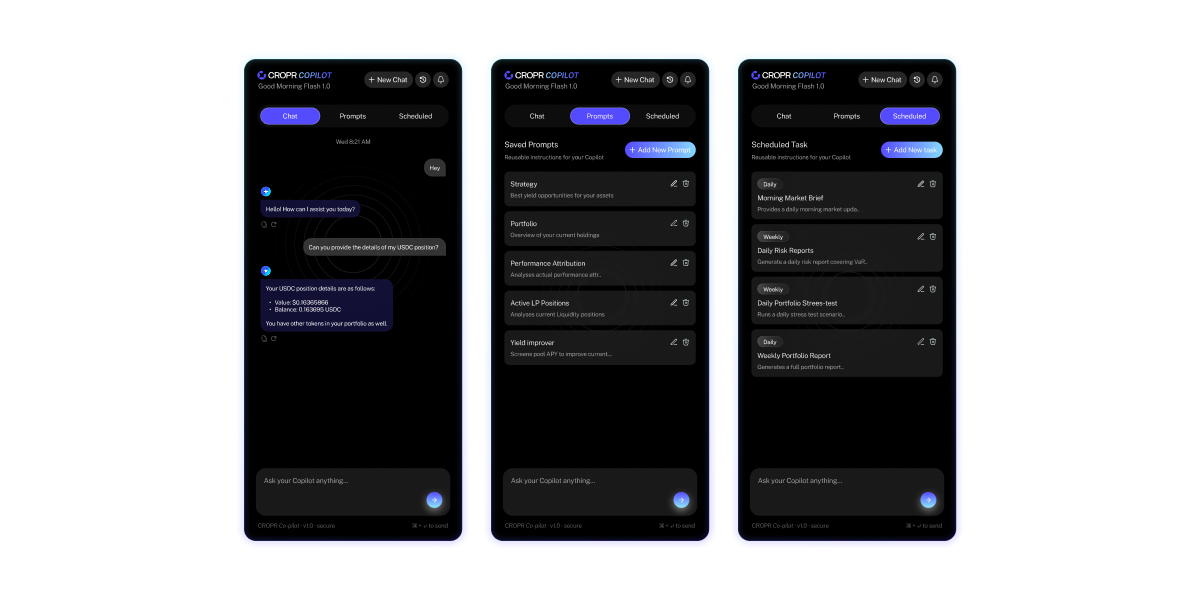
Our Copilot brings real-time market and portfolio intelligence directly into the operating workflow by allowing natural-language exploration of your exposure, historical P&L, live yield shifts, and environmental changes across protocols. This allows our users to receive an answer grounded to their current portfolio state, not a dated, generic market commentary.
Within the Copilot, our agent architecture enables automation of a higher order of operations outside of simple examination. Complex, multi-step analytical tasks can all be constructed as agent tasks that execute continuously, at a precision and consistency no human team can match: position monitoring against custom thresholds, risk alerts triggered by specific market conditions, scheduled reporting assembled from live onchain data.
What comes next
Traditional finance is moving onchain. Composable, cross-asset structures that stack native yields, using RWAs as collateral, are rapidly becoming regulated, rational investment vehicles. CROPR has positioned itself for professional users to capitalize on the fragmented, modern financial landscape.
The use of AI within our platform will take on an increasingly expanding role: monitoring, rebalancing, risk assessment, and even strategy construction. However, this transition must be gradual, precise, and well governed to ensure safety. The CROPR team believes that model security, deterministic guardrails, and deliberate human oversight are not constraints on ambition, but are the conditions under which full automation earns trust. The overall interface itself will evolve deliberately and as the AI Copilot becomes the primary point of interaction, this will allow users to surface information on demand and execute agentically within the boundaries each user defines.
We envision AI-constructed, AI-managed composable strategies, operating within governance-defined parameters, that will increasingly displace traditional fund structures, with CROPR as the platform on which they are built.
While our primary focus is on institutional compatibility, we are openly inviting retail and other professional users. A mobile application is prepared for launch — giving any user genuine access to asset management and professionally curated vault strategies matched to their risk profile. Beyond portfolio access lies the fuller promise: banking-grade accounts and payment services alongside investment capabilities.
Full wealth control, self-custodied and permissionless, CROPR will be the orchestration and integration layer to scale for decentralized finance.


