Beyond Agentic Trading: Why Agentic Strategy Management Matters in Digital Assets
By CROPR TeamAgentic trading lets AI trading agents monitor markets and place orders on a user's behalf. But many onchain strategies, such as lending arbitrage, looped lending, and delta-hedged liquidity provision, are not single trades. They are based on spreads that need to be managed continuously. Their biggest risks often come from borrow rates, token pegs, protocol parameters, and hedge drift rather than price itself. Agentic strategy management organizes AI agents around a strategy's written mandate, with specialist roles, pre-agreed responses, code automations for urgent actions, and human approval for irreversible steps. However, it only removes the delay in responding to risk, not the risk built into the strategy itself.
The idea of an AI agent is much older than the products now carrying the name. Researchers were describing computer programs that could sense, reason, and act in the1950s itself. What changed recently is the scope of what agents can act on. Because of their speed and automation capabilities, agents in trading was an obvious step. The starting point was simple conditional orders: ‘sell BTC when it reaches $100,000’, or ‘buy when the bid-ask spread narrows to a set level’, etc. This was still useful because AI trading agents can watch more markets than a person, follow conditions without fatigue, and apply the same rule at 3 am. as at 3 pm. For a trader, a well-built execution agent could take a lot of manual work off the desk.
But so far, we have only talked about the agent being organized around the execution order. It answers when to buy, when to sell, how much, and at what price. In fact, most automated trading strategies work this way, built around signals and the orders they trigger.
The AI handles execution and discipline while the user focuses on strategy and goals. However, that works only when the strategy is simple enough. When the strategy is the hard part, it leaves the most important job without a manager. This is where CROPR’s agentic trading feature stands out.
Most Onchain Strategies Are Spreads, Not Bets
It’s fair to say that most AI trading strategies are built to answer a directional question. Something like whether an asset price go up or down? However, most onchain strategies ran by professional teams are not directional bets at all. Lending arbitrage, for instance, borrows an asset where it is cheap and supplies it where it earns more. Looped lending deposits collateral, borrows against it, and redeposits the proceeds to get leverage on a yield. While a delta-hedged liquidity provision earns trading fees from an LP, a short serves as a hedge for the price exposure.
What these strategies have in common is that they all earn a spread. The return is the gap between two moving numbers: a supply rate and a borrow rate, a staking yield and a funding cost, trading fees and the cost of keeping a hedge in place. Opening the position to exploit a spread takes a handful of transactions. The profits are earned over weeks, provided the spread stays open for that long.
Spreads are also often unforgivingly thin. But that’s where things get tricky. A strategy that consistently earns a few percentage points a year can lose all of it and maybe some more through one slow response to a sudden rate change or a hedge that drifts for a day or two too long. As we've covered before, this is where a fund's alpha quietly leaks away. This happens not in the big decisions, but in the delay of the response.
The Price Chart Is the Wrong Thing to Watch
The ETH staking loop is probably the clearest example of why a price-driven agent can simply go wrong. Let’s suppose a trader deposits a liquid staking token such as wstETH or weETH on a lending market like Aave and borrows WETH against it. Let’s say she then stakes that ETH, deposits the result, and repeats. Each round creates leverage. So the trader earns staking yield several times over, minus the borrowing cost.
This is most certainly not a niche trade. In fact, Galaxy Research's August 2026 snapshot of Aave V3 found that roughly 9% of positions held about half of the protocol's debt. Most of it was in this ETH correlation trade, with an average health factor near 1.065 and debt-to-equity around 10.7 times. On Aave, a position becomes eligible for liquidation once its health factor falls below 1, which means these positions run with very little room.
Now, from a digital asset risk management perspective, this is the counterintuitive part. Since the collateral and the debt are both ETH-based, a fall in the ETH price barely moves the health factor. Because both sides fall together. That means an agent that watches the ETH chart and reacts to it is reacting to the variable that matters least for this position. While the variables that actually decide whether the loop survives, and whether it pays, sit somewhere else.
When the Loop Stops Paying
To drive the idea home, let's take a look at what the ETH staking loop strategy looks like in practice. Suppose a trader starts with 100 ETH and loops it into 400 ETH of staked-ETH collateral against 300 ETH of WETH debt. Staking pays 3% a year and borrowing costs 2%. Let’s say the collateral earns 12 ETH, the debt costs 6 ETH, and the trader keeps 6 ETH. That is a 6% return on their own capital, double what staking alone would pay. So far, so good.
Now ETH falls 20%. But measured in ETH, nothing has changed. 400 ETH of collateral still backs 300 ETH of debt, and the health factor stays the same. Now suppose instead that ETH's price holds steady but the borrow rate jumps to 5% as lenders pull ETH out of the pool. The debt now costs 15 ETH a year against the same 12 ETH of staking income. The loop is now losing 3% a year, while the health factor has barely moved. In fact, you will notice that any borrow rate above 4% will turn this position negative.
This is the same funding risk we covered in our article on digital asset lending. So, it’s completely natural for a position to sit comfortably away from liquidation while making a loss. Leverage makes it steeper. Also, don’t forget that the borrow rate is only one of the variables a loop depends on. There are others:
- The peg: Liquid staking tokens can trade below their underlying value during a sell-off. Suppose the trader has to unwind and she sells 400 ETH of collateral at a 5% discount. The 20 ETH loss wipes out a fifth of her capital (the 100ETH she started with).
- Risk parameters: A protocol's risk managers may lower a collateral's liquidation threshold during stress. Cutting it from, say, 95% to 92% creates a tighter position for the trader, moving the health factor from 1.10 to 1.065 in a single update.
- Slashing: When staking validators are penalised, the collateral itself shrinks. A 1.5% slash on 400 ETH removes 6 ETH, or 6% of the trader's equity.
None of these is a trading signal in the usual sense. However, each one is a change in the conditions the strategy relies on. Managing the loop means knowing which of them matters, deciding in advance what to do about each, and acting within minutes when one starts to move.
CROPR’s Agentic Strategy Management Solution
Inside CROPR, the agents’ goal is not to decide the next order. Instead they follow a strategy, laid out as clear rules. They constantly monitor whether the strategy is still operating within its mandate, and if not, what response was agreed upon for this situation.
The mandate comes first: For CROPR’s agentic framework to play out as intended, the person or team responsible for the strategy should set its limits before any agent runs. The limits include target leverage, acceptable ranges, the conditions that trigger a response, and who must approve which actions. Agents will always work inside that document. A good mandate ideally turns many of the hardest calls into decisions made calmly, before markets start moving.
Different jobs need different roles: Tasks like watching borrow rates, checking a peg, deciding whether adding leverage back is worth it, preparing transactions, and reporting to stakeholders, etc should be treated separately. Splitting them across specialist agents makes it easier to limit what each one can see and do, and to tell which one acted when something goes wrong.
Preparing is not executing: Similarly, stages including reading data, recommending a response, preparing a transaction, approving it, signing it, and confirming the result, etc. should also be treated differently. For example, an agent that prepares a deleveraging transaction has not executed it. Keeping those stages separate is what makes human approval meaningful rather than a formality.
Urgent maths belongs in code: When a health factor needs restoring within minutes, the calculation should run as deterministic code with predictable timing and output. Language models are better used for judgement. They can interpret an unusual combination of signals, explaining what happened, or choosing which pre-agreed response fits a situation the rules didn't anticipate.
Doing nothing is a valid response: If a staking token briefly trades at a discount on thin liquidity, selling into it can lock in a loss the market would have reversed. A good strategy manager, human or agent, knows when holding is the safer choice, and the mandate should say so explicitly.
How CROPR Excels at Agentic Trading
CROPR supports AI portfolio management through an assistant with multiple agents and Skills, prompt-led portfolio and position analysis, scheduled prompts and alerts, and trade preparation for explicit wallet signing. Let’s see how CROPR’s mandate-driven team of agents would act on a portfolio of a vault curator at different ranges of the health factor. For a wstETH/WETH staking loop, that mandate sets up a team of specialist agents, each with a defined role and none able to act outside the mandate's rules. At the centre of the design is a health band, a set of pre-agreed zones that decide who responds and how.
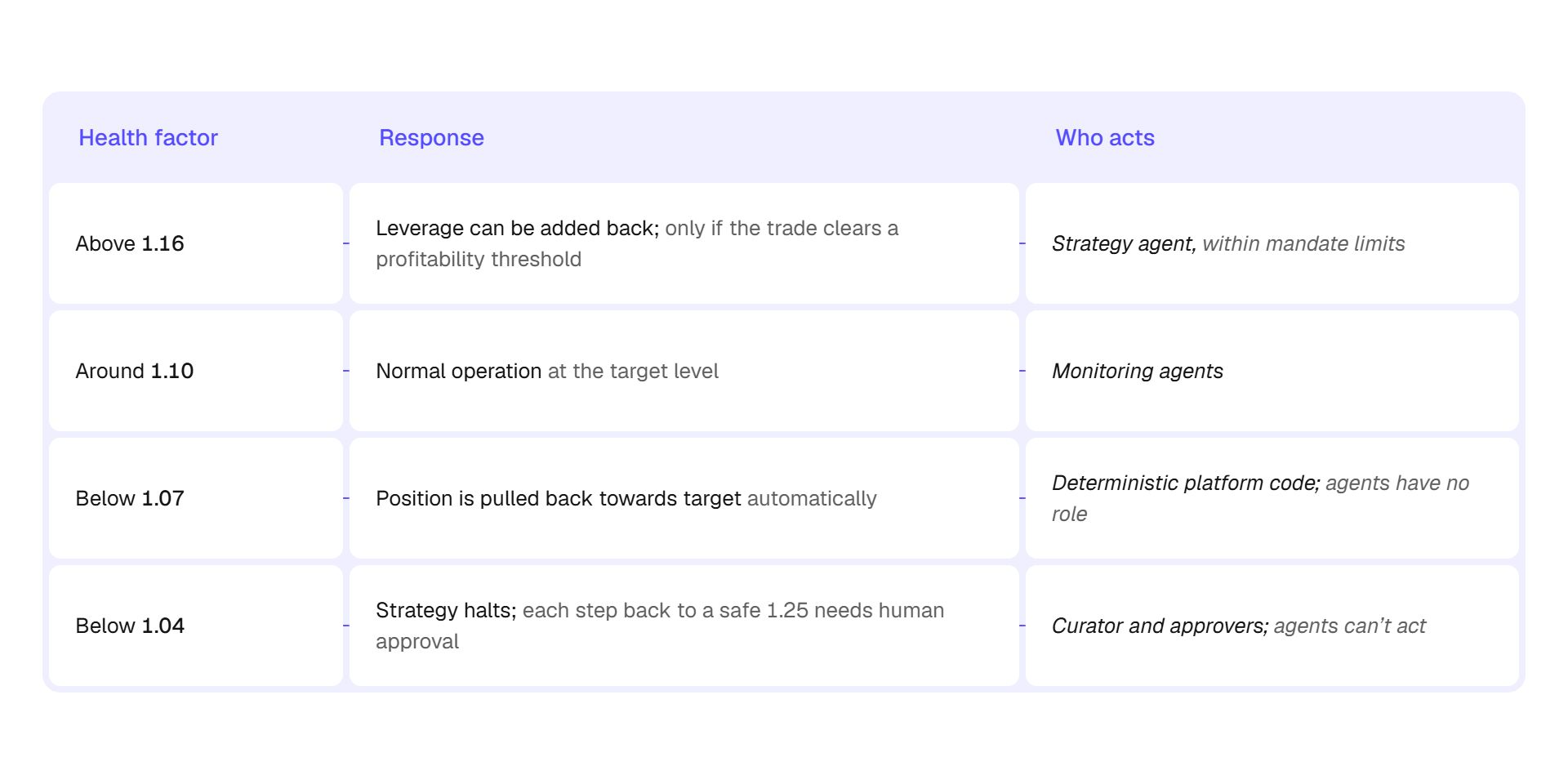
The approval rules are deliberately kept strict. Each de-risking step would need a curator vote within five minutes. Resuming the strategy needs two of three approvers, and only the curator can exit the strategy entirely. Risks that don't show up in the health factor, such as a borrow-rate spike or a peg discount, will each map to their own pre-written response. In a depeg or a data outage, that response can be to hold and transfer to human decision.
We tested this blueprint across twelve scenarios in its strategy simulator, using a hypothetical 4,000 ETH vault and scripted stand-ins for the agents. These are modelled results, not live ones, but they show which part of the system does what when the market moves.
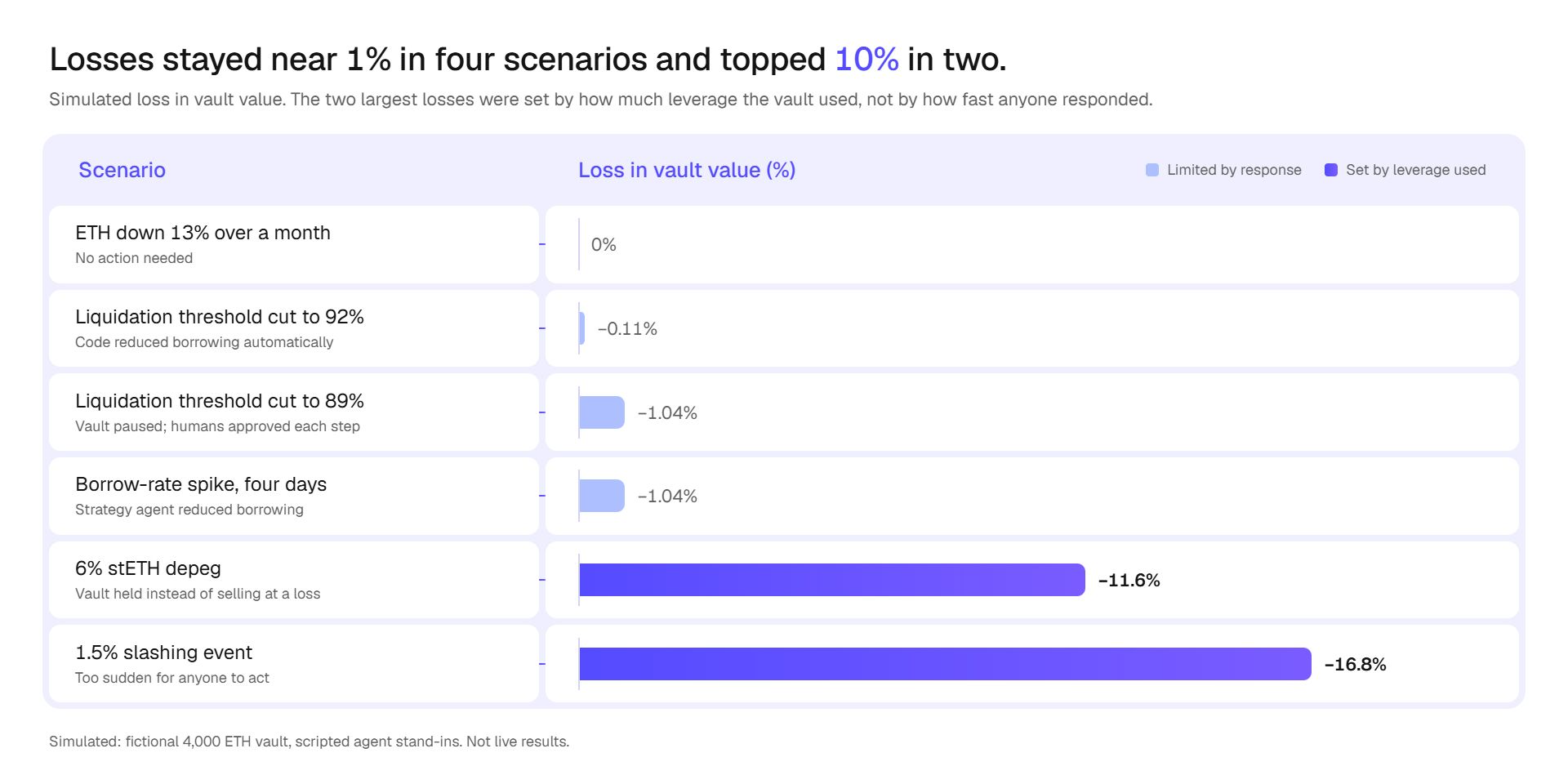
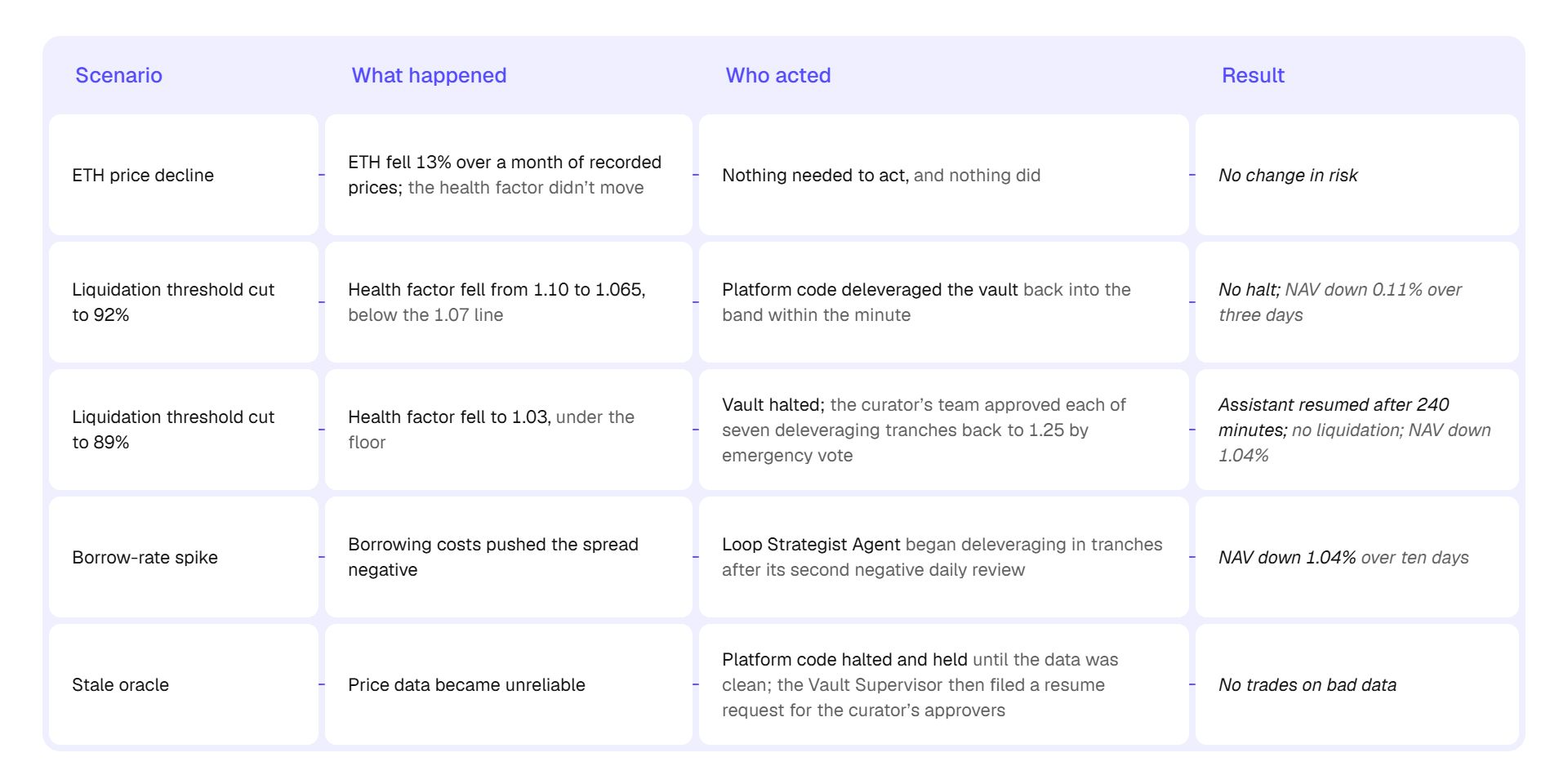
The situations that went wrong are just as instructive as the ones that got it right. In a 6% stETH depeg, the mandate's rule is clear: past a 3% discount, the vault halts and holds rather than selling into it. That prevented any liquidation, but at 7x leverage, marking wstETH at market price still took 11.6% off NAV per share over two weeks. A 1.5% slashing event took 16.8% off NAV, and no agent could catch it in time because the health factor stayed above the line. The only defense there is a leverage cap set in the mandate before the event.
The same pattern carried over to other strategies. In a delta-hedged liquidity blueprint, a Uniswap liquidity position is paired with a short ETH hedge on Hyperliquid. In a falling market, the liquidity position accumulates ETH and the hedge moves away. Code resizes the short as the position changes, and the strategy halts if the hedge moves too far from its target.
Agents Remove Delay, Not Risk
The failed simulations make an important case. Agents can remove the delay and the panicked decision, but they cannot remove the risk built into a trade. A 6% depeg on a heavily leveraged loop hurts no matter how quickly anyone responds. The size of that loss was decided much earlier, when the mandate set how much leverage the strategy could carry.
That shifts risk rather than removing it. A strategy run by agents is only as sound as its mandate. Limits that are too loose will be followed faithfully into a large loss. Limits that are too tight can trigger costly unwinds in conditions that would have passed on their own.
There are practical limits too. Agents depend on data, and a stale price or a failing data provider can lead them to the wrong conclusion. Onchain actions depend on block space, which gets scarce and expensive exactly when everyone is trying to act. Smart contract risk, protocol governance decisions, and validator behaviour all sit outside any agent's control. And every additional agent is another component that needs permissions, testing, and monitoring of its own.
None of this is an argument against agents. In fact, it’s the opposite. The message here is that we should be clear about what the agents are for: having a well-designed strategy behave the way it was designed, at any hour, without improvising under pressure.
The Bottom Line
The first wave of agentic trading has been about giving agents access to markets. That was a necessary step. But access to an order book doesn't tell an agent what a strategy needs, which risks actually matter, or when the right move is to wait.
For complex strategies like lending loops, yield spreads, and hedged liquidity, the valuable work happens between trades. The correct strategy should include watching the variables move, responding under agreed-upon rules, and letting humans in charge when necessary. If you build agents around the trades, you will get faster orders. Instead, if you build them around the strategy, you get a position that behaves the way you intended, even at 3 a.m. on a Sunday. That is the direction CROPR is building in.
Frequently Asked Questions
What is agentic trading?
Agentic trading means connecting an AI agent to a trading account so it can monitor markets and place, modify, or cancel orders on a user's behalf. Exchanges such as Coinbase, Kraken, OKX, and Binance now offer this through MCP, letting users connect models like Claude or ChatGPT to their accounts and describe a strategy in plain language.
What is agentic strategy management?
Agentic strategy management uses AI agents to manage a strategy over its whole life rather than to place individual trades. Agents work inside a written mandate that sets limits, triggers, and approval rules, and they monitor the variables the strategy depends on, such as borrow rates, token pegs, protocol parameters, and hedge ratios.
How is agentic strategy management different from agentic trading?
Agentic trading is organized around the order: when to trade, what, and how much. Agentic strategy management, on the other hand, is organized around the strategy: whether it is still operating inside its mandate and what pre-agreed response applies when it isn't. A strategy manager may still use trading agents to prepare and route orders.
Can AI trading agents execute Digital Asset transactions on their own?
Some can, depending on the permissions and wallet setup they are given. For strategies that carry real capital, a safer design separates preparing a transaction from approving and signing it, runs urgent calculations as deterministic code, and requires human approval for irreversible steps such as exiting a strategy.


